

The Four Exit Profiles
What Happens When You Map OMS Against EBITDA
Most founders think about exit value through one lens: revenue.
Sophisticated buyers use two.
The first is financial performance — EBITDA, margins, growth rate. The numbers the business produces. The second is structural maturity — how independently the business operates, how clearly it sees itself, how efficiently it converts revenue into retained wealth. The Operational Maturity Score measures this.
Revenue tells you what the business earns. OMS tells you what it's worth to someone who won't be running it with you in the room.
Map those two dimensions against each other and you get four distinct exit profiles. Each has a different valuation outcome. Each has a different fix sequence. Each is worth understanding before the LOI arrives.
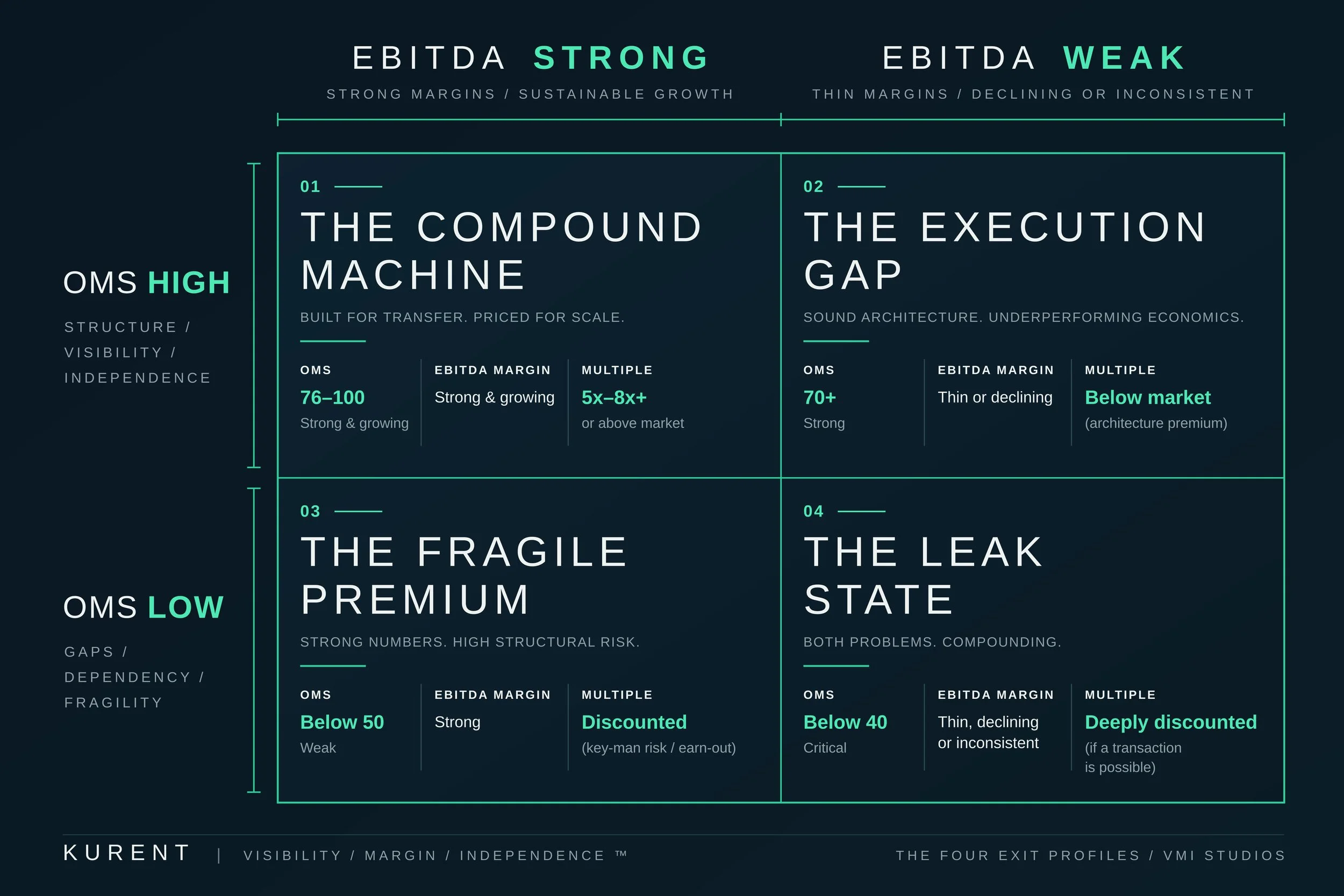
Quadrant 1: The Compound Machine
High OMS · Strong EBITDA
This is the business a buyer pays a premium multiple to own.
The architecture is sound. The economics reflect it. Visibility is real-time and decision-relevant. Margin is structurally protected — not dependent on the founder's personal attention to stay intact. Independence is built: the team makes decisions, processes run without routing through the founder, and the business functions consistently whether or not the founder is in the building.
The EBITDA is real and it is transferable. A buyer acquiring this business is acquiring a machine, not a dependency.
What this looks like at exit: the due diligence process is short because the data is clean and accessible. The buyer's risk assessment produces a low key-man discount because the business demonstrably runs without the founder. The multiple reflects the structural certainty of future performance — not just historical results.
OMS 76–100. EBITDA margin strong and growing. Multiple: 5x–8x or above market.
The fix sequence for businesses in this quadrant: maintain the architecture. The primary risk is founder re-entry — the habit of pulling decisions back to the founder during growth phases, which erodes the Independence that produced the premium. The Compound Machine requires active maintenance, not just construction.
Quadrant 2: The Execution Gap
High OMS · Weak EBITDA
This is the most undervalued profile in the market.
The architecture is sound. The economics don't reflect it yet. The business has strong Visibility — it can see its own performance clearly. It has Independence architecture — decisions route through systems, not the founder. But the Margin pillar is underdeveloped. There are Profit Leaks the business can see but hasn't sealed. Pricing that hasn't been stress-tested. Scope creep that gets absorbed because the relationship is good. Revenue lines where the economics haven't been examined at the engagement level.
The structural foundation is there. The financial performance hasn't caught up yet.
What this looks like at exit: a sophisticated buyer — one who can read the OMS signals beneath the financials — sees exactly what this is: an underperforming asset with a sound operating system. They pay a below-market multiple and extract the margin improvement themselves. The founder leaves value on the table that was structurally accessible.
OMS 70+. EBITDA margin thin or declining. Multiple: below what the architecture deserves.
The fix sequence: Margin architecture before exit. The Independence is already built, which means the founder has the capacity to examine the economics without the business falling apart. Seal the Profit Leaks. Stress-test the pricing. Examine the engagement-level margins on every service line. A business in this quadrant can move from below-market to above-market multiple without a revenue increase — by fixing the economics that the architecture was already capable of protecting.
This is the quadrant where the Multiplier Effect is most accessible. The architecture already exists. The financial performance just needs to catch up with it.
Quadrant 3: The Fragile Premium
Low OMS · Strong EBITDA
This is the most dangerous quadrant. And the most common in founder-led businesses between $3M and $10M.
The numbers look strong. The structure doesn't support them.
EBITDA is healthy — but it is healthy because the founder is personally catching everything. Scope creep that should be billed is being absorbed by the founder's relationships. Quality standards are being maintained by the founder's direct involvement in delivery. Margins are holding because the founder is the margin protection mechanism.
Remove the founder and the EBITDA changes.
This is what the Multiplier Effect describes as the key-man discount in its most expensive form. The revenue is real. The transferability isn't. A buyer looking at this business sees strong historical performance and high structural risk. Their mitigation is a lower multiple or a multi-year earn-out that chains the founder to the business after the transaction.
OMS below 50. EBITDA margin strong. Multiple: discounted for key-man risk, often paired with earn-out structures.
The fix sequence: Independence architecture before exit. The business needs to demonstrate — not claim — that it can perform without the founder in the operational center. This means building the decision frameworks, documentation, and authority structures that let the team maintain the EBITDA without founder presence. The target is 12–24 months of demonstrated performance without founder involvement in delivery before the exit conversation starts.
The Fragile Premium is the profile that most surprises founders at the transaction table. They arrive expecting to be paid for the EBITDA they built. They find they are being discounted for the structural risk they created in building it.
Quadrant 4: The Leak State
Low OMS · Weak EBITDA
Both problems are compounding simultaneously.
The architecture is missing. The economics reflect the absence. Visibility gaps mean the business is making decisions on information it doesn't fully have — pricing that doesn't reflect true cost, capacity that isn't being planned ahead of demand, margin performance that isn't visible until it's already a problem. Independence failures mean every decision routes through the founder, compressing capacity and making the business structurally unable to grow without the founder growing proportionally. Margin leaks are running undetected through all of it.
This is not exit territory. This is structural intervention territory.
In VMI terms, this profile sits in the lower half of the Codex — potentially approaching Zero Vector Collapse at its most severe, where all three forces are misaligned and every resource deployed cancels another out.
OMS below 40. EBITDA margin thin, declining, or inconsistent. Multiple: if a transaction is possible at all, it is deeply discounted.
The fix sequence is the VMI sequence, applied with urgency: Visibility first, always. The business cannot fix what it cannot see. Install the reporting infrastructure that makes the Margin leaks visible. Then seal the leaks. Then build Independence. In that order. The sequence is not optional — it is a structural dependency.
The good news for businesses in this quadrant: the fix sequence is known, the intervention points are clear, and the $1M–$10M window is still open. The architecture is still designable. The cost of fixing it is highest here — but it is still lower than the cost of arriving at the transaction table with both problems intact.
What the 2×2 Tells You Before the Transaction
The four exit profiles are not just a post-hoc analysis of outcomes. They are a predictive map.
If you know your OMS score and you can read your margin performance, you know which quadrant you're in before any buyer conversation starts. You know what your multiple will likely be. You know what fix sequence produces the most exit value in the time you have. You know whether you're building a Compound Machine or a Fragile Premium.
Most founders discover their quadrant at the transaction table, when the leverage has already shifted to the buyer.
The OMS Diagnostic is designed to tell you which quadrant you're in while there is still time to change it.
The architecture is designable. The sequence is known. The window is open.
The OMS Diagnostic locates which quadrant you're in. That's the only place the design can begin.
Scale isn't luck. It's architecture.
This post is a companion to The Multiplier Effect, which examines how each VMI pillar moves the exit multiple in founder-led businesses.
